

If you opened Photoshop today, there’s a good chance you’d use it to design a flyer, book cover, retouch a photo, remove someone’s ex from a vacation picture, or spend 45 minutes trying to get one layer to behave.
But here’s the funny part: Photoshop wasn’t originally created for graphic designers. Not really.
The story of Photoshop starts in the late 1980s with a computer scientist, his brother, a black and white Macintosh, and a problem that had absolutely nothing to do with designing Instagram posts.
It Started With a Photo
In 1987, Thomas Knoll was working on his PhD in computer vision at the University of Michigan. While working on his thesis, he ran into a frustrating problem: his computer wasn’t displaying grayscale images properly. So, he started writing a little software to fix it.
That little program could display grayscale images on his Macintosh. Thomas’s brother, John Knoll, who worked on special effects at Industrial Light & Magic, saw what he was doing and immediately recognized that the program could do much more than display pictures.
The brothers began expanding it. They added features that allow users to manipulate images, make adjustments, and work with different file formats. The program was initially called Display, which, honestly, doesn’t have quite the same ring to it.
John eventually convinced Thomas to turn the experiment into a proper image editing program. After demonstrations and some serious interest from companies, Adobe licensed the software.
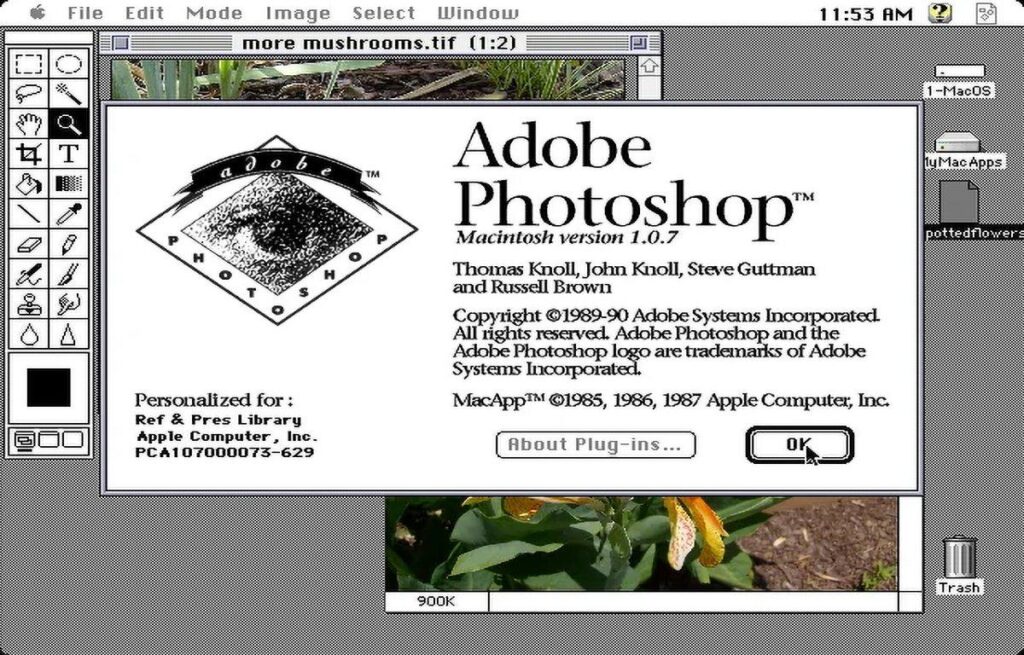
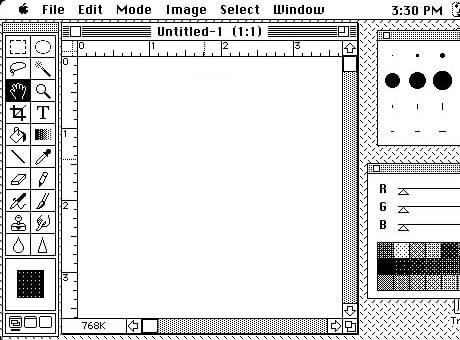
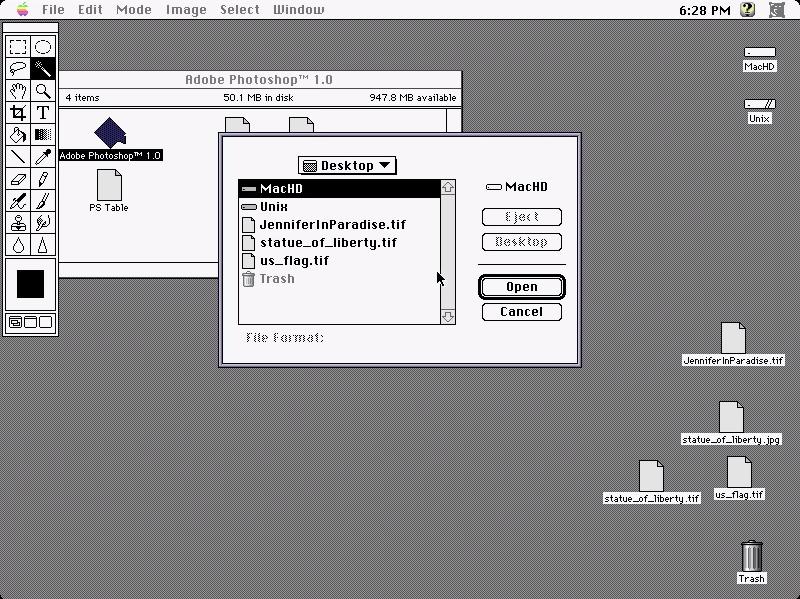
In February 1990, Adobe Photoshop 1.0 was released for Macintosh computers.
So What Was Photoshop Actually Made For?
At its core, Photoshop was created for digital image manipulation. Not book covers. Not logos. Not social media graphics. And definitely not making your friend’s head weirdly large.
The original idea was much simpler: as photography became increasingly digital, people needed a way to edit and manipulate those digital images. Photoshop provided the tools to do exactly that.
And then designers got their hands on it. That’s where things got interesting.
Photoshop wasn’t specifically designed as a graphic design application, but designers quickly realized that if you could manipulate pixels, you could also use those pixels to create things. Photographs could be combined with typography. Textures could be added. Images could be distorted, layered and transformed. Suddenly, Photoshop wasn’t just a place to edit photographs. It was a creative playground.
Then Came Layers
One of Photoshop’s biggest turning points came with Photoshop 3.0 in 1994, when Adobe introduced layers.
If you’ve ever worked in Photoshop, you probably don’t think twice about them. But layers completely changed how designers could work. You could put your background on one layer, your photograph on another, your typography on another, and that weird texture you refuse to delete on layer 37.
Instead of permanently changing an image every time you edited it, you could work with separate elements and experiment more freely. That flexibility helped push Photoshop beyond photography and deeper into graphic design, advertising, publishing and visual communication.
Over the years, designers started using Photoshop for practically everything: book covers, movie posters, album artwork, advertisements, digital illustrations, web graphics, photo manipulation, and concept art. Eventually, Photoshop became so closely associated with image editing that “Photoshop” became a verb.
You don’t just edit a photo anymore.
You Photoshop it.
That’s quite the journey for software that started because someone wanted a computer to display grayscale images properly. The most interesting thing about Photoshop’s history is that its creators weren’t sitting around thinking, “Let’s build the ultimate tool for graphic designers.”
Thomas Knoll was solving a problem with digital images. John Knoll saw the potential. Adobe saw a product. Designers saw possibilities. And that’s probably the best lesson in the whole story.
Sometimes, the people who create a tool decide what it’s for. The people who use it decide what it can become. Photoshop started as a solution to a fairly technical problem. It eventually became one of the defining tools of modern visual culture.
Not bad for something originally called Display.